Claude Opus 5 Launched: Near Fable 5 Power at Half the Price, Benchmark and Comprehensive Comparison
Claude Opus 5 launches at $5 per million input tokens and $25 per million output tokens, with a context of 1 million tokens, approaching Fable 5 performance on some benchmarks but at half the price. A comprehensive analysis of specs, coding, agent, safety, and migration.
Claude AI logo. Source: Anthropic, via Wikimedia Commons, CC0.
Claude Opus 5 is not Anthropic's most powerful model, but it might be the most important one for professional users
Anthropic officially introduced Claude Opus 5 in an announcement dated July 24, 2026, US time. The post from the Claude account appeared on July 25 in Vietnam time, with a brief but very notable message: this is a "cautious and proactive" model, approaching the frontier capabilities of Claude Fable 5 but at half the price.
The key point lies in how Anthropic positions the product. Fable 5 still has higher overall capability, meant for the most ambitious projects and agents that can operate over multiple days. Opus 5 is designed to be a more frequently used choice: powerful enough for coding, agents, research, and complex enterprise work, but without forcing users to pay the $10 per million input tokens and $50 per million output tokens like Fable 5.
Claude Opus 5 maintains the same price as Opus 4.8: $5 per million input tokens and $25 per million output tokens. The model has a one-million-token context window, a maximum output of 128,000 tokens on the synchronous Messages API, adaptive thinking, multiple effort levels, and the API ID claude-opus-5. Anthropic makes Opus 5 the default model on Claude Max and the most powerful model for Claude Pro users.
This is not just another benchmark score increase. Anthropic is trying to solve the bigger problem of the AI market in 2026: how to make a model that can think carefully, self-check, work for a long time, and produce complete products while keeping the cost per task reasonable. If the claims are consistently reproduced on real-world workloads, Opus 5 could become the "daily driver" for developers, AI Creators, analytics teams, and enterprises, while Fable 5 is reserved for tasks that truly require the highest level of capability.
Anthropic logo. Source: Anthropic, via Wikimedia Commons.
Official specifications of Claude Opus 5
Category
Claude Opus 5
Practical Significance
API ID
claude-opus-5
Model snapshot without a date but described by Anthropic as a fixed version, not an alias that changes silently
Input Price
$5/million tokens
Same as Opus 4.8 and half of Fable 5
Output Price
$25/million tokens
Same as Opus 4.8 and half of Fable 5
Context window
1,000,000 tokens
Suitable for large codebases, many documents, long agent histories, and complex dossier analysis
Maximum output
128,000 tokens
Can generate long documents, code, or artifacts; Message Batches beta allows up to 300,000 output tokens
Thinking
Adaptive thinking
Model self-adjusts reasoning level based on the task; does not use the old extended thinking mechanism
Default Effort
High on API and Claude Code
Can lower or raise effort to optimize cost, latency, and quality
Relative Latency
Moderate
Faster than Fable 5, slower than Sonnet 5
Reliable Knowledge Cutoff
May 2026
More recent than Fable 5 and Sonnet 5 according to the official model table
Fast mode
Approximately 2.5x default speed
Priced at double the base rate
US-only inference
1.1x base price
For workloads requiring processing within the US
Beyond standard pricing, Anthropic continues to offer prompt caching, which can save up to 90% on reused input, and Batch API with a 50% discount. This is particularly important for long-lived agents, as a large portion of costs can come from repeatedly sending system prompts, documents, project rules, repository maps, and work history.
How is Claude Opus 5 different from Claude Fable 5 and Sonnet 5?
Model
Input/Output Price
Context
Latency
Best Fit
Claude Fable 5
$10/$50 per million tokens
1M
Slower
Frontier tasks, multi-day agents, projects needing maximum capability
Claude Opus 5
$5/$25 per million tokens
1M
Moderate
Complex coding, production agents, research, and daily enterprise work
Claude Sonnet 5
$3/$15 per million tokens, with a lower launch price until August 31, 2026
1M
Fast
High volume, workflows needing speed, balanced cost and intelligence
Claude Haiku 4.5
$1/$5 per million tokens
200K
Fastest
Classification, extraction, customer support, and high-volume tasks
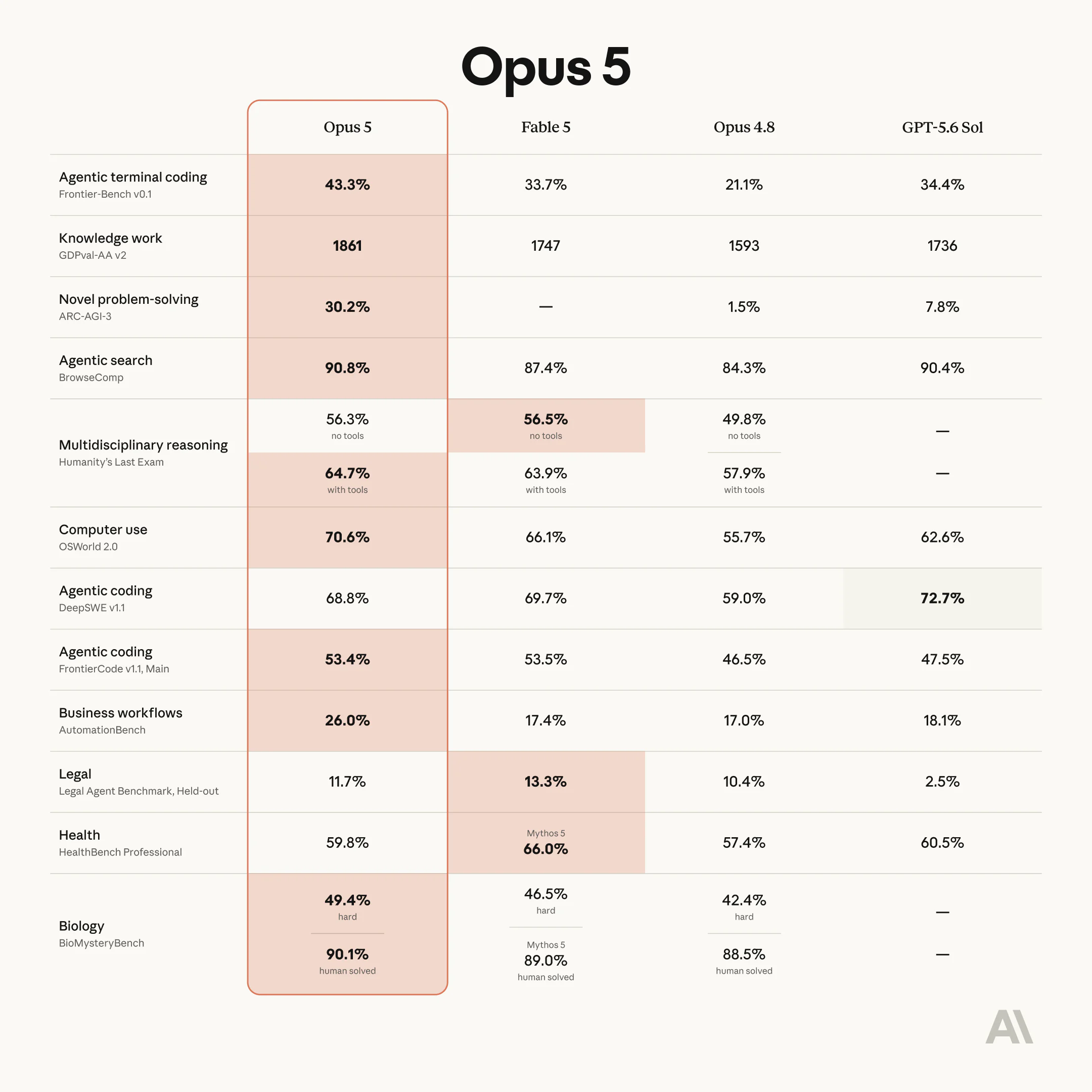
The message "near Fable 5 at half the price" does not mean Opus 5 equals Fable 5 in every domain. Anthropic clearly states Opus 5 still trails Mythos 5 in cybersecurity, and Fable 5 remains the choice when users need the highest capability. On CursorBench 3.2 at max effort, Opus 5 scored only about 0.5% below Fable 5's peak, but at half the cost per task. This is a specific result in a specific harness, not evidence that Opus 5 replaces Fable 5 on all workloads.
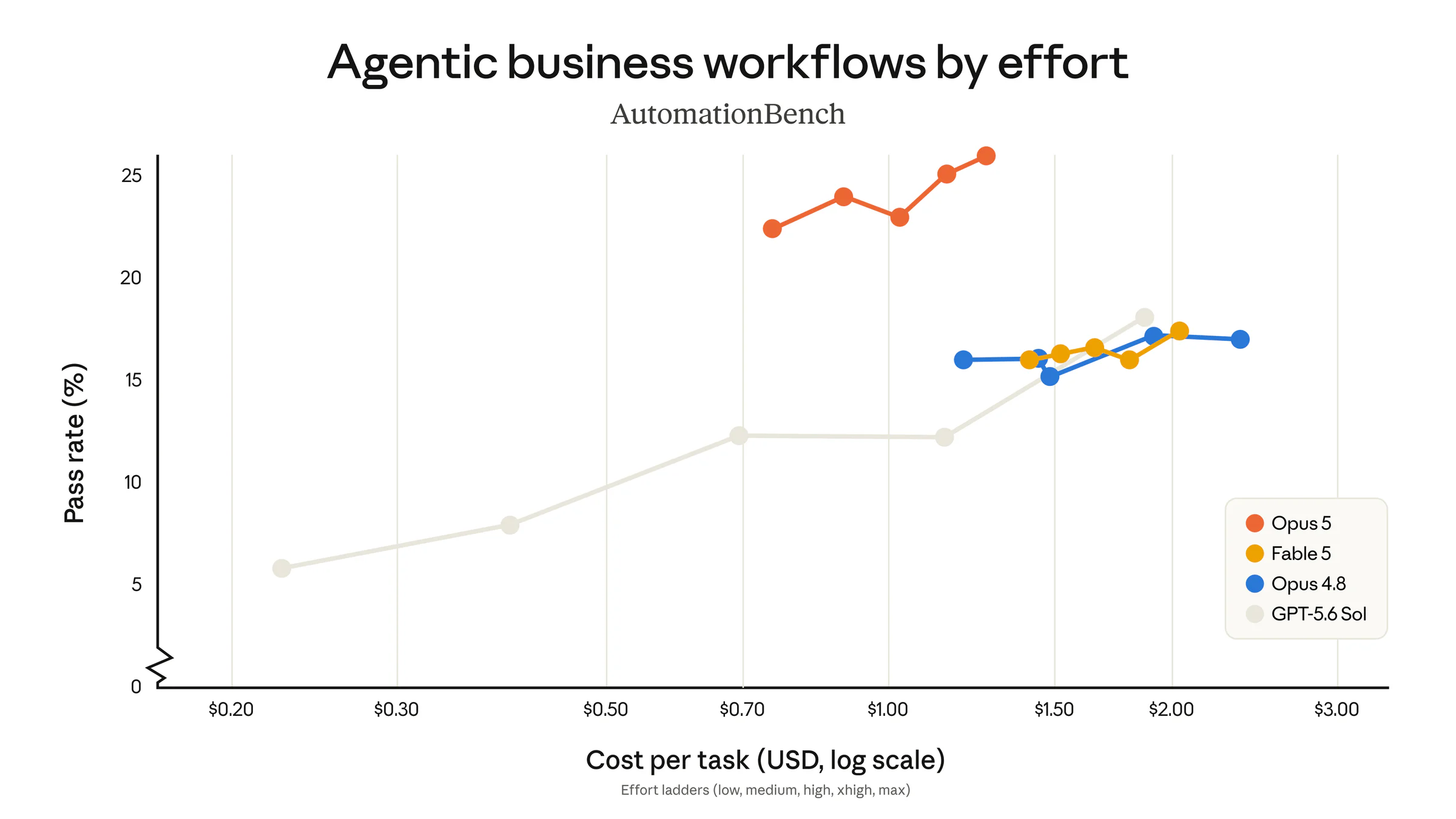
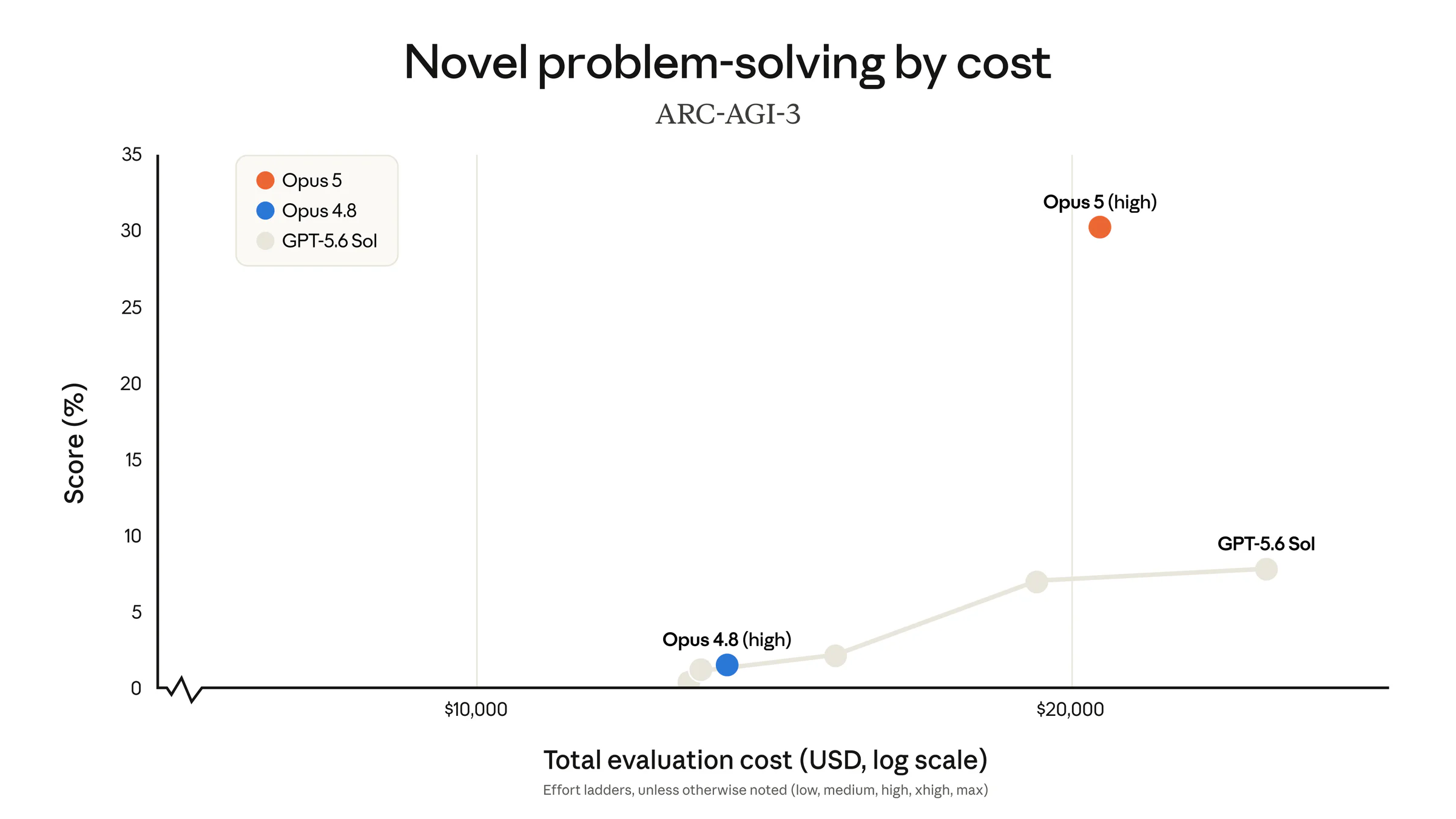
The practical appeal is the performance-per-cost curve. Anthropic says Opus 5 produces better results at the same cost across many high, xhigh, and max effort settings. Users can keep max effort for tough bugs, large migrations, or multi-step research, but lower effort for routine code reviews, document summaries, or repetitive tasks.
Claude.ai web interface. Photo: Orwell reader/Wikimedia Commons.
Coding Benchmarks: Opus 5 Focuses on Reliability and Cost Per Task
Frontier-Bench v0.1
Anthropic says Opus 5 tops Frontier-Bench v0.1, achieving more than double the performance of Opus 4.8 while having a lower cost per task. Results were run using a mini-SWE-agent on a GKE backend, taking the mean reward from five attempts per task. Opus 4.8 was used as a fallback when Opus 5 or Fable 5's safety classifier refused a request.
This fallback detail is important when reading the benchmark. Some runs labeled Opus 5 may have been completed by Opus 4.8 after the classifier triggered. This does not invalidate the benchmark, but it shows the results measure a production system consisting of a model and guardrails, not just the raw model weights.
CursorBench 3.2
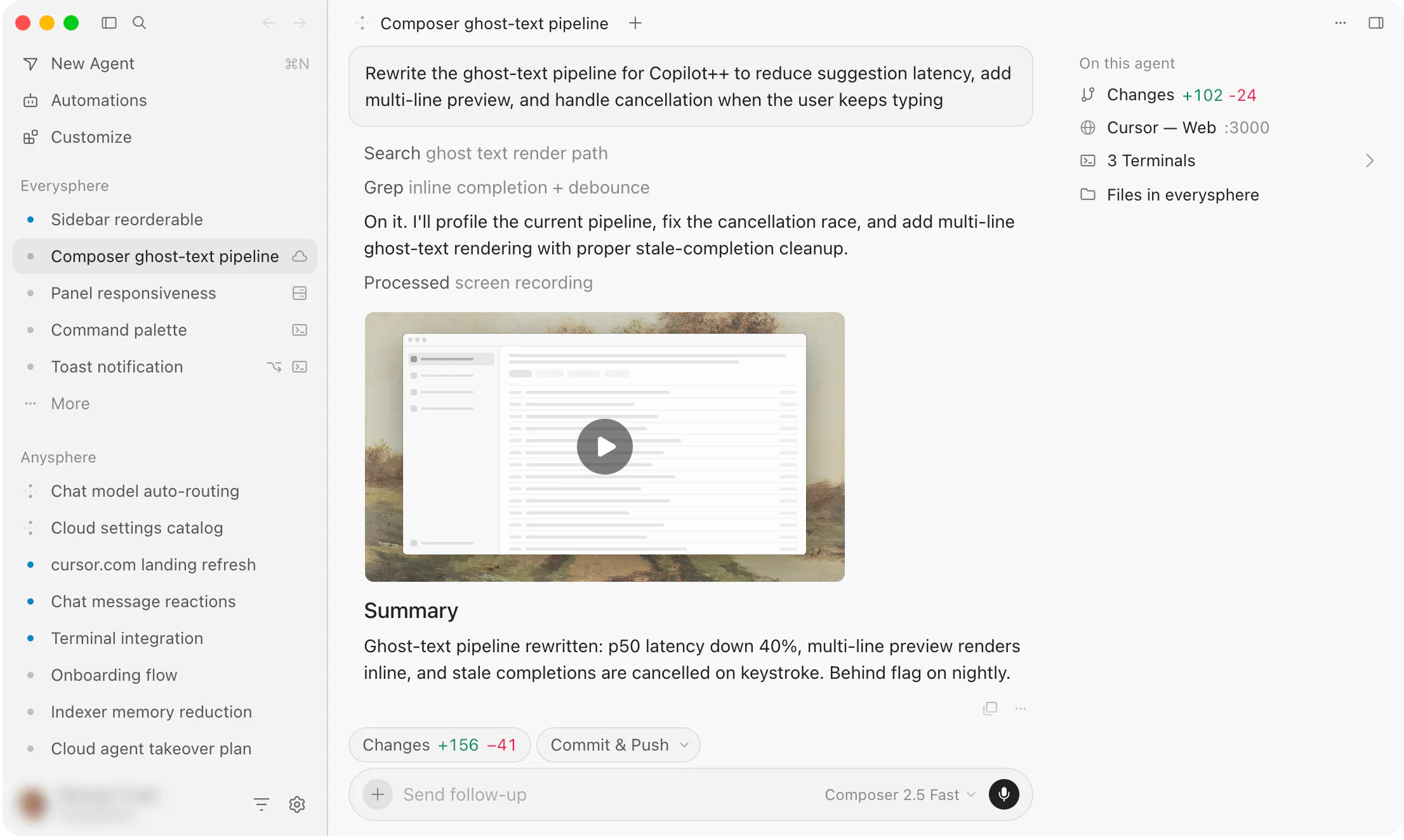
At max effort, Anthropic reports Opus 5 is only about 0.5% below Fable 5's highest score, but at half the cost per task. A Cursor representative said the model exhibits many behaviors similar to Fable 5 and fits well with in-editor coding workflows.
For developers, "near Fable" is only valuable if results are stable across runs. A model with high scores but high variance will force teams into more reviews, more retries, and unpredictable costs. Testing partners like Lovable reported Opus 5 is less variable, while also showing a 22% improvement over Opus 4.7 on their hardest agentic coding task suite. This is an internal evaluation from early customers, so it should be seen as a deployment signal rather than an independent benchmark.
Cursor AI Coding Agent interface. Photo: LrgFranzones/Wikimedia Commons.












Bình luận
0 bình luận
Đăng nhập để tham gia thảo luận cùng cộng đồng!
Đăng nhập ngayĐang tải bình luận...