Gemini 3.6 Flash Launched: API Pricing, Benchmark, Features and Comprehensive Comparison
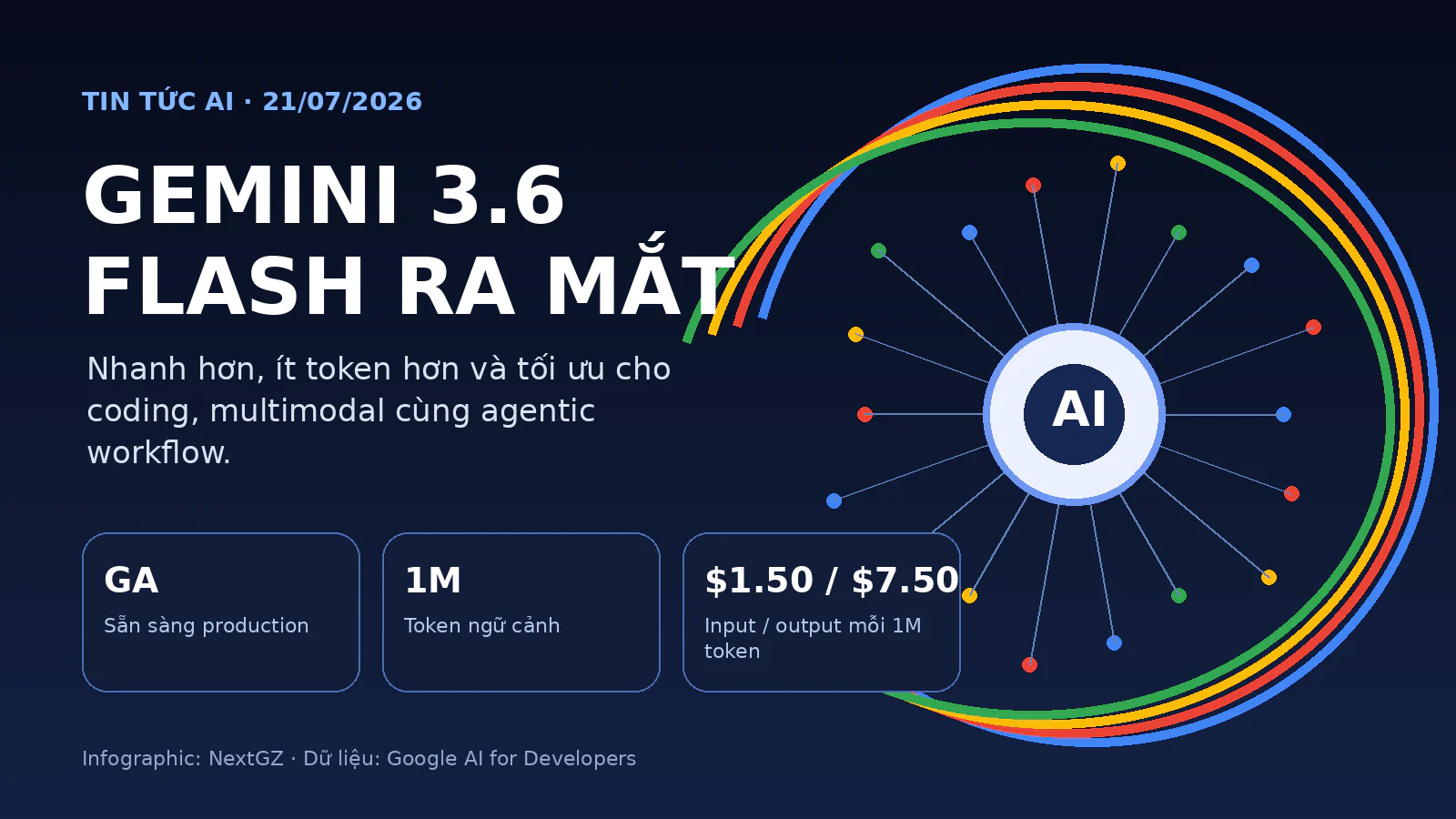
Gemini 3.6 Flash launched on July 21, 2026 with a one million token context, output price reduced to $7.50, better coding and Computer Use, fewer tokens and tool calls than Gemini 3.5 Flash.
1:04 ước tính · Chưa có giọng vi-VN
Gemini 3.6 Flash launches: API pricing, benchmarks, features, and comprehensive comparison
Google released Gemini 3.6 Flash to the market on July 21, 2026, but this is not simply a version number bump. The most notable change lies in how the model completes tasks: using fewer output tokens, reducing reasoning steps and tool calls, writing more accurate code, and lowering output pricing compared to Gemini 3.5 Flash.
For general users, Gemini 3.6 Flash is the new model appearing in the Gemini app. For developers and businesses, the greater significance lies in its Generally Available status, the stable model ID gemini-3.6-flash, a one-million-token context window, and a tool suite ready for production agent deployment.
The announcement on the Google AI Studio account quickly drew attention because Google released Gemini 3.6 Flash before Gemini 3.5 Pro was ready. This shows that the 2026 AI race is not just about the most powerful model, but has shifted to a more practical question: which model can get the most work done with the lowest cost, latency, and number of tool calls?
Gemini 3.6 Flash officially launched on July 21, 2026
In the official announcement on July 21, Google simultaneously introduced Gemini 3.6 Flash, Gemini 3.5 Flash-Lite, and Gemini 3.5 Flash Cyber. The three models have different objectives, but all reflect a common priority: increasing efficiency for large-scale AI agent systems.
Google calls Gemini 3.6 Flash a "workhorse" model—the primary model for workloads that need to balance intelligence, speed, and cost. It is built directly from feedback from developers and customers using Gemini 3.5 Flash, focusing on coding, knowledge work, multimodal processing, and multi-step workflows with tool calls.
The model is GA, not preview. Developers can use it immediately via the Gemini API in Google AI Studio, Android Studio, and Google Antigravity. Enterprises can access it through the Gemini Enterprise Agent Platform and the Gemini Enterprise app. General users can also select the model in the Gemini app.
Full Gemini 3.6 Flash specs
Category | Details |
|---|---|
Model ID |
|
Status | Generally Available, production-ready |
Input data | Text, images, video, audio, and PDF |
Output data | Text |
Input limit | 1,048,576 tokens |
Output limit | 65,536 tokens |
Default thinking |
|
Standard pricing | $1.50/1M input tokens, $7.50/1M output tokens |
Model caching | Supported |
Code execution | Supported |
Computer Use | Supported in Preview |
Function calling | Supported |
File Search | Supported |
Google Search and Maps grounding | Supported |
Structured outputs | Supported |
URL Context | Supported |
Image generation | Not supported |
Audio generation | Not supported |
Live API | Not supported |
The specs show Gemini 3.6 Flash is a multimodal understanding model but only outputs text. It can read images, video, audio, PDFs, and combine those data sources in a single request, but it is not an image generation or real-time audio conversation model.
The most important new feature: fewer tokens and fewer loops
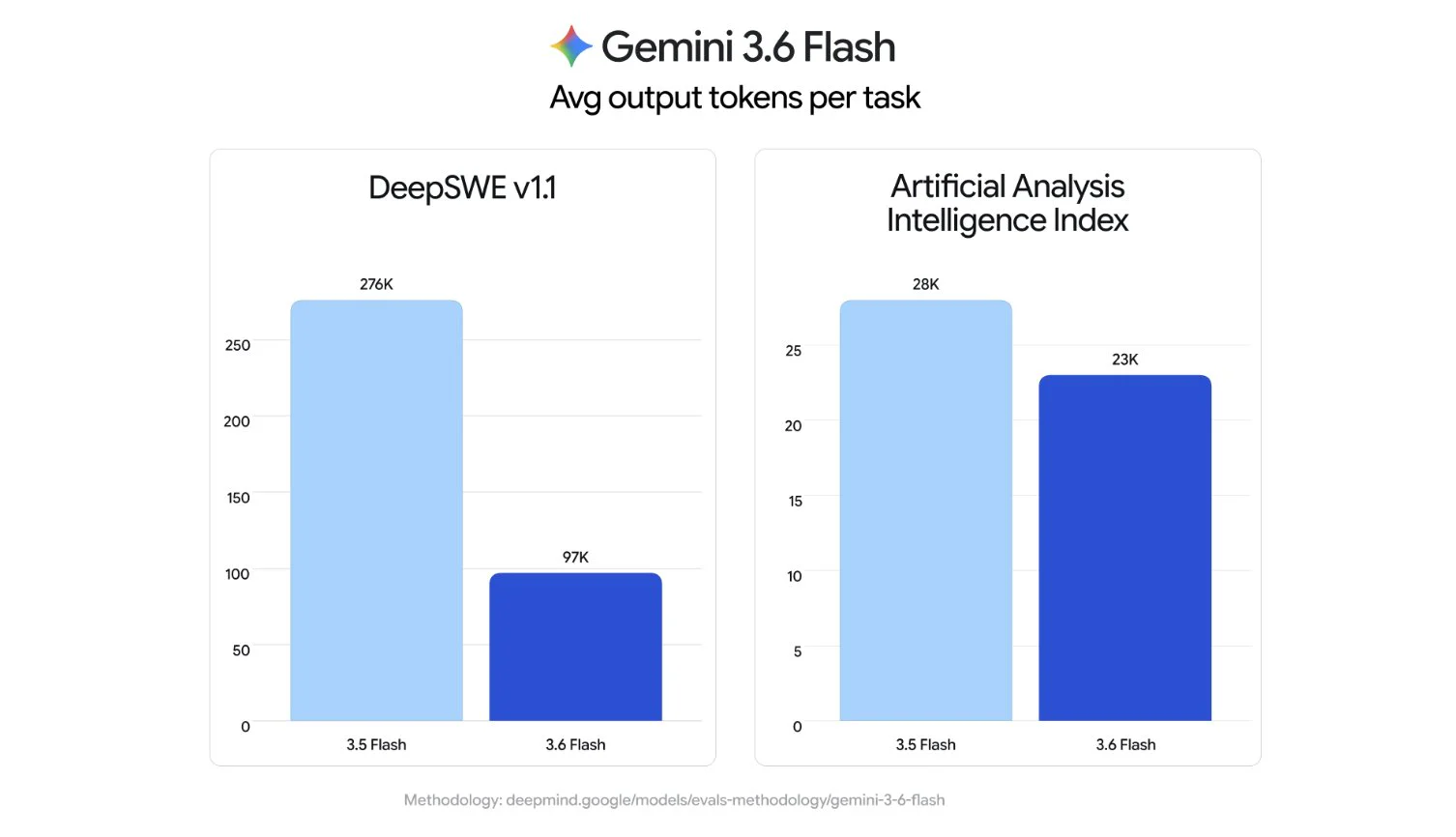
Google says Gemini 3.6 Flash uses 17% fewer output tokens than Gemini 3.5 Flash on the Artificial Analysis Index. In some coding agent measurements like DataCurve's DeepSWE, token reduction can reach up to 65%.
Token reduction isn't just about a lower bill. In a multi-step agent, each output segment can become input for the next step. The more verbose the model, the more tokens the system has to shuttle back and forth, costing extra time, context, and money. When Gemini 3.6 Flash completes the same goal with fewer reasoning turns, fewer conversational turns, and fewer tool calls, the entire pipeline becomes leaner.
This change is especially important for workflows like reading a repository, finding bugs, editing code, running tests, opening a browser, collecting data, and then synthesizing a report. The real cost of an agent isn't decided just by token unit price, but also by the number of loops the model needs to reach the final result.
Gemini 3.6 Flash benchmarks vs. Gemini 3.5 Flash
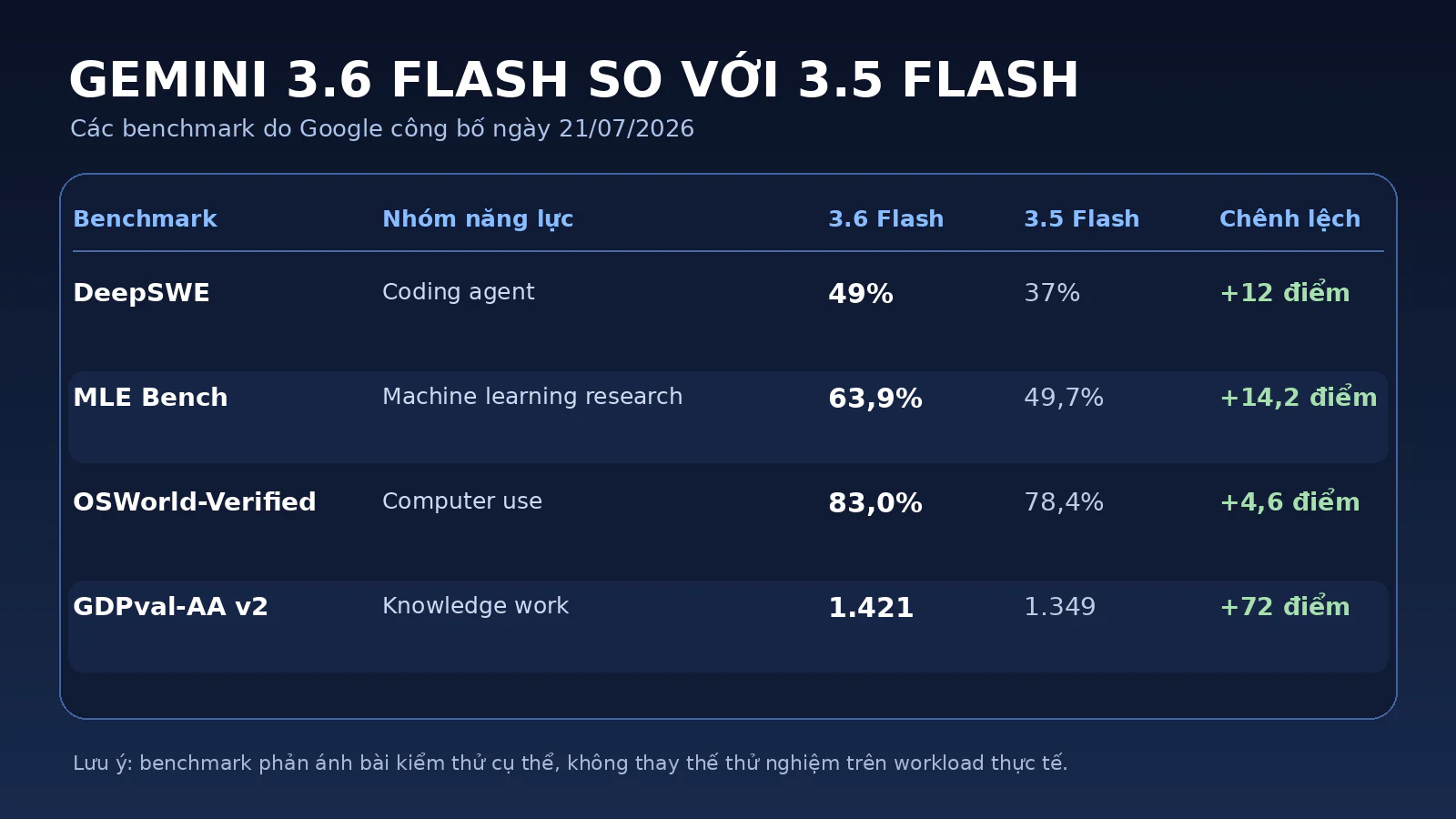
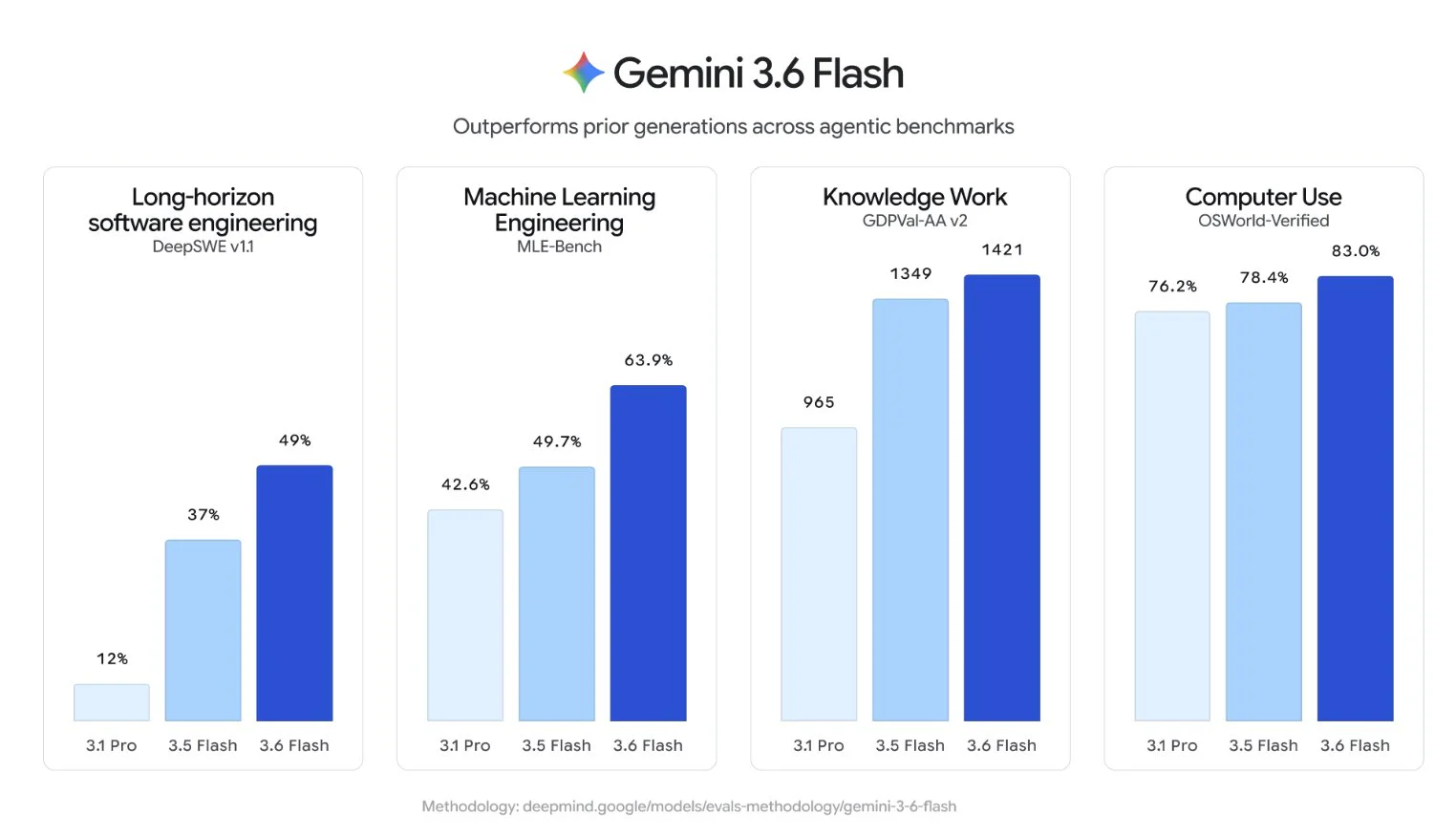
In the set of benchmarks Google published, Gemini 3.6 Flash outperforms its predecessor in coding agent, machine learning research, computer use, and knowledge work.
Benchmark | Gemini 3.6 Flash | Gemini 3.5 Flash | Difference |
|---|---|---|---|
DeepSWE | 49% | 37% | +12 points |
MLE Bench | 63.9% | 49.7% | +14.2 points |
OSWorld-Verified | 83.0% | 78.4% | +4.6 points |
GDPval-AA v2 | 1,421 | 1,349 | +72 points |
DeepSWE reflects the ability to work within a coding agent workflow. MLE Bench focuses on machine learning research. OSWorld-Verified measures the ability to operate a computer in a near-real environment. GDPval-AA v2 evaluates knowledge work tasks such as document analysis, data analysis, and report drafting.
Benchmarks do not guarantee every project will improve by exactly these percentages. Repository, framework, toolset, prompt, and output standards can cause results to vary significantly. The most reliable evaluation method is still running the same set of real tasks on both Gemini 3.5 Flash and 3.6 Flash, then measuring completion rate, number of edits, number of tool calls, total tokens, and final cost.
How is Gemini 3.6 Flash better at writing code?
Google describes Gemini 3.6 Flash as having higher accuracy, fewer out-of-scope edits, and reduced execution loops. These are three common time-wasters when using a coding agent.
Older models might fix one bug but simultaneously change formatting, file structure, or unrelated code blocks. When the edit scope expands, users have to check more diffs and the risk of regression increases. Gemini 3.6 Flash is optimized to stick to the diagnosis, keep changes narrower, and reduce the "fix-break-fix" cycles.
The model also tends to run diagnostic scripts before editing code. For complex bugs, this approach helps gather evidence before changing the system. However, Google's developer documentation notes that it may introduce exploratory steps when handling simple frontend tasks.
One point worth clarifying: code that works correctly does not necessarily mean the interface looks better. In human evaluations, some older models are still preferred for layout and styling. When using Gemini 3.6 Flash to build interfaces, the brief should clearly specify design systems, spacing, typography, breakpoints, interaction states, and visual standards.
Multimodal and spatial reasoning capabilities upgraded
Gemini 3.6 Flash accepts text, images, video, audio, and PDFs in a single model. Google emphasizes improvements in reading charts, data analysis, converting visual blueprints into digital structures, and creating multi-element web layouts.
For AI Creators, this opens up more practical workflows than just sending text prompts. Users can input a research PDF, interface screenshots, data tables, demo videos, and ask the model to create a unified analysis. For websites, the model can read a screenshot of the current UI, compare it with code, and suggest changes. For content, the model can extract information from charts or long documents before building outlines and articles.
Although it understands images better, Gemini 3.6 Flash does not generate images. Tasks requiring image generation or editing must still be routed to dedicated image models in the Gemini ecosystem.
Computer Use becomes an important Gemini API tool
Gemini 3.6 Flash supports Computer Use as a native tool in Preview status. Instead of only answering instructions, the model can participate in an agent that manipulates interfaces, navigates applications, and completes sequences of tasks on a computer.
On OSWorld-Verified, the model achieves 83.0%, up from 78.4% for Gemini 3.5 Flash. The improvement is not just about "looking at the screen," but also depends on planning, determining the next action, checking state after each operation, and recovering when the UI changes.
Computer Use still needs tight guardrails. Actions like sending emails,
Đánh giá bài viết
More from author
 Unity
UnityUnity prototype sạch ngay từ ngày đầu: thư mục, assembly boundary và quy tắc đặt tên cho indie team
Three.js từ trang trắng đến scene 3D đầu tiên: camera, renderer, ánh sáng và vòng lặp animation
Godot prototype đầu tiên: hiểu Scene, Node và Resource bằng một mini game có thể mở rộng
 Màu Sắc & Ánh Sáng
Procreate Selection nâng cao: Feather, Save & Load, Color Fill và ColorDrop cho flat màu sạch
You might also like

 Tin Tức AI
Claude Opus 5 Ra Mắt: Gần Sức Mạnh Fable 5 Với Nửa Giá, Benchmark Và So Sánh Toàn Diện
 Tin Tức AI
DeepSeek-V4-Flash-0731 chính thức ra mắt: Agent vượt V4-Pro-Preview, hỗ trợ Codex
 Công cụ & Phần mềm
10 plugin Codex biến AI viết code thành một nền tảng làm việc thực thụ
 Tin Tức AI

Bình luận
0 bình luận
Đăng nhập để tham gia thảo luận cùng cộng đồng!
Đăng nhập ngayĐang tải bình luận...