How to Convey Character Age Through Body Proportions in Anime and Manga
11 min read
1:04 ước tính · Chưa có giọng vi-VN
How to Convey Character Age Through Body Proportions in Anime and Manga
Whether a character looks "younger" or "more mature" often doesn't come from the face alone. The sense of age also lies in body proportions, especially the relationship between the head, torso, limbs, hands, feet, shoulders, hips, and jaw. In figure drawing, an average adult is typically measured at about 7.5 heads tall, while idealized figures in art and illustration are often stretched to 8 heads or more. Clip Studio also emphasizes that artists often adjust these "ideal" proportions to emphasize a character's personality and style, provided they understand the fundamentals of anatomy first.
Therefore, when you want to draw a character who looks like a teenager, the important thing isn't just to "draw them a bit shorter." What needs adjusting is which parts are relatively longer, which are relatively shorter, and which parts haven't yet developed the full weight of an adult. This article follows that exact logic: don't memorize rigid measurements, but learn how to push the feeling of age with small but well-placed changes.
During puberty, the body doesn't grow all at once simultaneously. According to HealthyChildren, hands and feet often develop first, making the body look a bit awkward at times; then the limbs catch up, followed by the torso lengthening, and depending on biological sex, shoulders or hips will gradually widen. The same source also notes that facial bones, especially the lower jaw, continue to develop, changing the appearance quite noticeably with age.
This is the key to character design. When you want to draw a younger person, simply make the limbs feel slightly long relative to the torso, the hands and feet slightly larger than expected, the torso shorter, and the jaw lighter, and the overall age changes very quickly. Conversely, to make a character look more mature, let the torso be longer, the limbs less "lanky", the hands and feet relatively less large, and the jaw more defined, lower, and heavier. That's how to turn the same basic design into two different ages without changing the face too much.
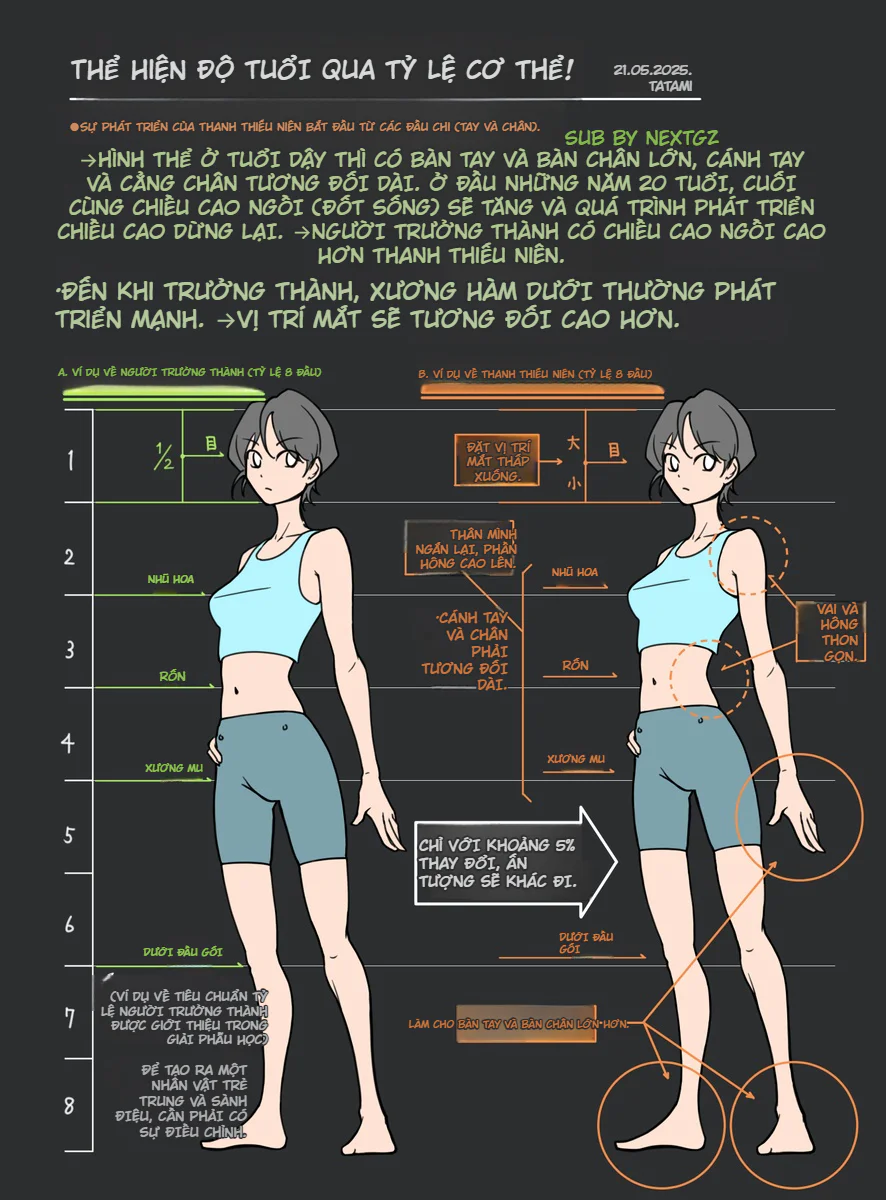
In the illustration, one side is constructed with adult logic, while the other is adjusted to look younger. This approach aligns perfectly with figure drawing thinking: the overall proportion measured in "heads" is the foundation to keep the figure from breaking. Proko uses head height as the unit of measurement for the whole body, considering the average adult to be about 7.5 heads tall, while idealized figures often approach 8 heads.
But when changing age, don't stop at just changing from 7.5 to 7 or 8 to 7.5. Changing the overall height alone isn't enough. A character can still look like a short adult if the torso, skeletal frame, and joints still carry a mature feeling. Therefore, treat the head-to-body ratio as a measuring framework, while the true sense of age lies in the distribution of length between body parts.
A very strong detail in the image is that the younger character has a shorter torso, especially the area from shoulders to hips. This fits well with body development data: after the stage where limbs, hands, and feet grow first, the torso gradually lengthens in subsequent growth. HealthyChildren describes this process very clearly: hands and feet grow first, then arms and legs catch up, and the trunk lengthens.
In character design, this means:
a younger character will be more convincing when you shorten the shoulder–navel–pubic bone distance, rather than just uniformly shortening the entire body. This is why in the image, when the torso is compressed a bit, the sense of age changes immediately even though the face remains almost the same.
This is the part most easily overlooked but also the most effective. The illustration strongly emphasizes that simply making the hands and feet a bit larger instantly creates a teenage feeling. This closely follows the description of body development during puberty: hands and feet grow first, so for a period, adolescents can look a bit clumsy or disproportionate because their peripheral limbs develop earlier than the torso.
For artists, this is an invaluable trick. When designing a character:
To look younger: increase the size of hands and feet relatively, no need to overdo it.
To look more mature: keep hands and feet neater and more "solid" in mass.
What creates the sense of age here is not absolute measurements, but the relationship between the limbs and the torso.
In the image, the younger version has shoulders and hips that are slimmer, with less skeletal weight. This is a logically sound choice. HealthyChildren notes that after the initial stage of puberty, boys' shoulders and girls' hips get wider, meaning the torso frame begins to show clearer signs of maturity.
When drawing a younger girl in anime or manga, this translates into very specific actions:
shoulders shouldn't be too "broad"
hips shouldn't have the clear weight of an adult silhouette
the waist can still be cinched, but the transition from shoulders–chest–waist–hips should be lighter
This way, the character retains a youthful feel without turning into a chibi or a child.
A very insightful note in the image is that the mature version gives the feeling that the eyes are "higher" relatively, while the younger version's eyes seem lower. The correct understanding here isn't to slide the eyes up and down too much, but that the lower part of the face changes. HealthyChildren clearly states that facial bones, especially the lower jaw, grow, and Clip Studio also notes that the proportions of facial features change with age; for example, children have smaller noses than adults, and the elderly have larger and droopier noses than middle-aged people.
For illustration, this leads to a very useful inference:
to make a character look older, don't just "translate the eyes upward." Increase the height of the lower face, making the lower jaw, chin, or nose–mouth area have more weight. When the lower part grows, the eyes will naturally feel positioned higher on the overall face. This is an adjustment that is both natural and less likely to break the style.
The image makes a very accurate observation: adults look like they have a greater sitting height than teenagers. This aligns with the reality of torso growth after the initial stage of puberty, when the trunk lengthens and the body feels less like "limbs leading, torso lagging behind."
In illustration, "sitting height" isn't for you to measure a chair. It's a way of thinking:
at the same overall height, a mature character will have a torso that occupies a higher proportion
a younger character will give the feeling that limbs occupy more visual space
This is why simply lengthening the torso a little makes the character look much more mature without needing to increase the overall height too much.
A common mistake is:
enlarging the feet but forgetting the torso
shortening the torso but keeping the shoulders too mature
lengthening the arms but keeping the hands too small
making the face youthful but the lower body too adult-like
Then the character will have a "mixed-age" look, with unclear intent. A more effective method is to adjust using proportion packages.
shorter torso
limbs that feel longer
relatively larger hands and feet
slimmer shoulders and hips
lighter jaw
head can remain slightly larger relative to an adult's feel
longer torso
less lanky limbs
relatively neater hands and feet
heavier shoulders/hips according to the designed gender
more defined jaw
slightly longer lower face
This way, the character's age changes synchronously, making it look much more convincing.
The great point of this image is that it shows sometimes only a very small change in:
relative eye position
torso length
limbs
hand and foot size
shoulder and hip weight
…immediately changes the age impression. This completely aligns with character design thinking: Clip Studio emphasizes that artists can adjust proportions from the ideal standard to emphasize personality and character type.
Therefore, when designing characters for comics, illustrations, or VTuber sheets, don't think "age" is just a number written in the profile. The audience will believe a character is young or mature primarily through body proportions before reading any description.
When you have a base character, I recommend adjusting in this exact order:
Step 1: Lock the overall height using head count.
Keep this as the framework; don't adjust randomly yet.
Step 2: Adjust the torso first.
To look younger, shorten the torso. To look more mature, lengthen the torso.
Step 3: Adjust limbs and extremities.
Increase or decrease hand and foot size according to the desired age feel.
Step 4: Adjust shoulders, hips, neck.
This is where the body frame starts to "show its age."
Step 5: Adjust the lower face.
No need to drastically change the face; just alter the feel of the jaw, chin, and nose-mouth area.
Step 6: Review the overall silhouette.
If the silhouette still gives the desired age vibe, then you can proceed to details like clothing, hair, and expressions.
Doing this is much faster than sitting and fixing small details one by one and still not achieving the right age in the end.
Many worry that if they follow anatomy and growth patterns too closely, their anime art will lose its essence. Actually, that's not the case. Clip Studio states quite clearly that artists can absolutely adjust proportions for their own style, provided they understand anatomy fundamentals first.
This means:
you can still keep the eyes large
you can still keep the legs long
you can still stylize the hips, waist, and shoulders
But if you want the character to read as the correct age, you need to have those changes follow age logic. For example:
a 16-year-old anime girl shouldn't have the same torso, limbs, and jaw as a 26-year-old anime woman if the goal is to clearly distinguish age.
two characters in the same style can still be distinguished by their mass proportions, not just by face and clothing.
To convey a character's age through the body, don't just look at overall height. What matters is the distribution of proportions. During puberty, hands and feet often develop first, then limbs catch up, the torso lengthens, shoulders or hips widen, and facial bones, especially the lower jaw, develop more noticeably. In character design, these changes can be translated into several highly practical actions: shortening or lengthening the torso, increasing or decreasing the size of peripheral limbs, slightly adjusting shoulders–hips, and changing the feel of the lower jaw. Just by getting these points right, the character's age will be read very quickly without breaking your anime/manga style.
Adjust to have a shorter torso, limbs that feel relatively longer, slightly larger hands and feet, and a lighter jaw. These are very effective cues to create a teenage feel.
In figure drawing, the average adult is typically measured at about 7.5 heads tall, while the idealized figure is usually 8 heads or more.
Because during puberty, hands and feet often grow first, so a teen's body can give the feeling that peripheral limbs developed earlier than the torso.
Don't just push the eyes up or down. Increase the sense of development in the lower part of the face, especially the lower jaw and nose–mouth area. This aligns with the reality that facial bones, especially the lower jaw, continue to develop.
No. Artists often adjust proportions to serve style and character personality, provided they understand the underlying anatomy and proportions first.

 Digital Art
 Tips học tiếng Trung
 Công cụ & Phần mềm
 Công cụ & Phần mềm
 Character Design
 Character Design
 Character Design
 Character Design
Đăng ký miễn phí, lấy link riêng và giới thiệu NextGZ cho người cần học tiếng Trung hoặc Digital Art.

Cộng đồng thực chiến
Tham gia nhóm để nhận tài nguyên, cập nhật công cụ và trao đổi cách xây dựng digital business cùng AI.
Tham gia nhóm Zalo
Cộng đồng sáng tạo
Kết nối với cộng đồng Digital Art, chia sẻ tác phẩm và học hỏi quy trình sáng tạo mới.
Tham gia DiscordCộng đồng thực chiến
Tham gia nhóm để nhận tài nguyên, cập nhật công cụ và trao đổi cách xây dựng digital business cùng AI.
Tham gia nhóm ZaloCộng đồng sáng tạo
Kết nối với cộng đồng Digital Art, chia sẻ tác phẩm và học hỏi quy trình sáng tạo mới.
Bình luận
0 bình luận
Đăng nhập để tham gia thảo luận cùng cộng đồng!
Đăng nhập ngayĐang tải bình luận...